I am always going back to art, over and over. Because I leave it. After a week, a month or just a day. Sometimes it is harder than others.
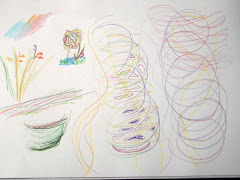
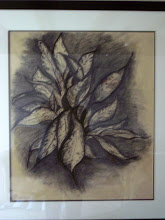
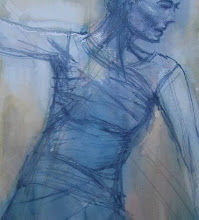
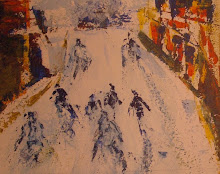
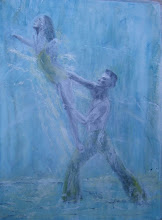
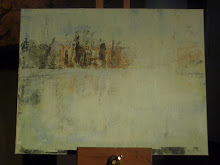
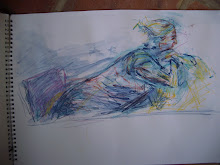
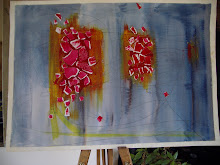
Yesterday I got back by painting 3 quick pictures on small bits of board. 20 mins max. Then the rest of the day on a bigger and much more difficult dance painting. It is shown here cropped severely, and yet maybe not enough.
Monday, 19 April 2010

Monday, 15 February 2010
Palette knife in action
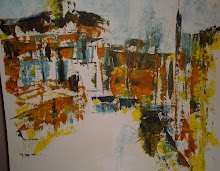
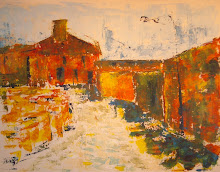
Finally sinusitis leaves and gives me headspace to paint. L. brings palette knives and we try slabbing on the paint. Leaving the white becomes important. Betty Edwards' colour book revealed that my favourite colours are light bright blue green orange/red. My cards from Lisbon are full of these colours.
Thursday, 14 January 2010
Keeping strength in reserve
I am enjoying the book "Life with Picasso" by Francoise Gilot and Carlton Lake. Gilot was (still is) an artist herself, 40 years younger than Picasso, and a very strong woman.
One of the things he told her:
"You must always work not just within but below your means. If you can handle three elements, handle only two. If you can handle ten, then handle only five. In that way the ones you do handle, you handle with more ease, more mastery, and you create a feeling of strength in reserve." (p. 50)
Just the opposite of 'aim for the moon, you may land among the stars' or 'work at the edge of your capabilities; that way you learn something new'. And it has a truth in it that appeals.
One of the things he told her:
"You must always work not just within but below your means. If you can handle three elements, handle only two. If you can handle ten, then handle only five. In that way the ones you do handle, you handle with more ease, more mastery, and you create a feeling of strength in reserve." (p. 50)
Just the opposite of 'aim for the moon, you may land among the stars' or 'work at the edge of your capabilities; that way you learn something new'. And it has a truth in it that appeals.
Sunday, 10 January 2010
Redon -- I await joyous surpises
Odilon Redon wrote in a letter to Charles Morice, 1911:
I am capricious. I float along on the infinite combination of the materials I touch. I believe that the artist yields to the stimulus of materials that will transport his spirit. I am sure of what I will not do, but not of what my art will bring about. I await joyous surprises while working, an awakening of the materials that I put to work and that my spirit develops.
A good work of art, made in one burst with tenacity, determination, passion as much as reason, should surpass the goal the artists has set for himself.
I am capricious. I float along on the infinite combination of the materials I touch. I believe that the artist yields to the stimulus of materials that will transport his spirit. I am sure of what I will not do, but not of what my art will bring about. I await joyous surprises while working, an awakening of the materials that I put to work and that my spirit develops.
A good work of art, made in one burst with tenacity, determination, passion as much as reason, should surpass the goal the artists has set for himself.
Saturday, 9 January 2010
Four paintings


I took the book "French Art at the Hermitage" and chose the four paintings that most appealed to me. Vlaminck, Redon, Cheret, Redon. Dynamic or quite still.
What next?
Snowbound art

Four days after the snow fell, it is still six inches deep and powdery. In the mornings, the cottage windows have a layer of ice on the inside, but the various heating sources soon make it warm and cosy. The blog is restarted to make contact with the world beyond the lane, or at least to feel as if there is contact.
I have been in my study writing so am surrounded by bits of paper with black and white typing on. Out of the window, the pond and hedges started looking like black and white typing too. I thought it would be fun to make a collage from my discarded drafts so tried - it turned into a 3d model of the pond with bits stuck on - rather like something children might bring home from school. So I just laughed and told myself "that's lovely, dear. Well done!" Perhaps Saatchi might like it.
The books and websites keep telling me to play, become like a child again. But they don't really mean that - it's something much more sophisticated that combines skill and expertise with imagination, not this clumsy gluing and sticking. I can make a story about the collage/3d model - how it turns my (too) serious academic work into a hedge and a brambly island in an icy pond - there are lots of potential metaphors in that. But even with a story, it doesn't look like art to me.
And I like the resonance (such a handily vague word that) between the seeds that fell out of the larch cones on to the card and looked just like the ducks' footprints in the snow as they walked and slid across the icy pond. When I look down from the study -my little ivory tower, except that the ivory is all outside - I see the duck tracks across and around, and even, this morning, a rabbit lolloping from bank to island. I had noticed, the day before, the same seeds scattered over the snow up by the edge of the wood, and thought how that must happen anyway, but how the snow made it visible. So I stuck on the seeds to seem like duck webprints.
And was it synchronicity that my John Lewis Christmas paper napkins had the very same muted green that the water at the edge of the pond took on when it began to freeze? So that those bits of the collage/model now remind me of Christmas and family who came to stay and eating mince pies. What rich reverberations that silly little collage/model has for me...
Friday, 29 May 2009
A poem about a painting

I had a lovely day at a workshop at Charleston. This is the outcome:
Vanishing Point (looking at -- Girl Wearing an Orange Shawl, c. 1894-1895, by Edouard Vuillard)
The little girl with her orange shawl
Appeared on my canvas
In response to the vermillion mark
I had placed at the vanishing point.
Diagonal leading there,
A line for the eye,
And the two of them, going
Towards it.
Cobalt blue in her hair
Jaunty and brave.
Will she be brave enough for this?
I mixed some of that cobalt blue
Into the cadmium orange hue
With a touch of Mars black.
Turned them under the palette knife
Colours bleeding into one another.
A greenish brown emerged,
Took her by the hand
And led her
Out of the picture.
Saturday, 16 May 2009
Friday, 8 May 2009
How does it feel?
Working - cross, annoyed, irritable, fed up, another cup of tea, chocolate, cross, pushing, scratching words into text.
Painting - amazing, daring, risky, safe, exciting, breathtaking, no more chocolate needed, tense, relief, amazing
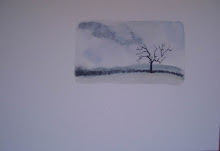
A tree in a stormy cloudscape materialises.
Painting - amazing, daring, risky, safe, exciting, breathtaking, no more chocolate needed, tense, relief, amazing
A tree in a stormy cloudscape materialises.
Monday, 20 April 2009
painting and exhibiting
Still trying to paint every day. One day I couldn't get started -- didn't know what to paint, so went across the road and sat under the chestnut tree by the pond. I brought back a twig in bud and drew/painted it as it came into leaf. I also spent a long time on the picture of the pond with chestnut tree in foreground. It's on canvas and I have to get used to how the paint works on this as opposed to how it works on paper.
The art group had an exhibition and I put in six pieces. It was strange to see people looking at them, and even worse when they looked straight past them. There were some compliments about a couple of the tree pictures but my overwhelming reaction to going public was negative - it seemed a rather shameful or embarrassing thing to do, to imagine them good enough to display and to spend all that money on framing pictures that would have been better painted over and reused. (not that much money, thanks to Ikea). Gradually re-finding my equilibrium and start a new class tonight...
The art group had an exhibition and I put in six pieces. It was strange to see people looking at them, and even worse when they looked straight past them. There were some compliments about a couple of the tree pictures but my overwhelming reaction to going public was negative - it seemed a rather shameful or embarrassing thing to do, to imagine them good enough to display and to spend all that money on framing pictures that would have been better painted over and reused. (not that much money, thanks to Ikea). Gradually re-finding my equilibrium and start a new class tonight...
Friday, 3 April 2009
Finding the space
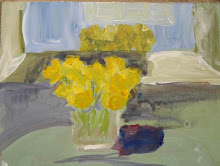
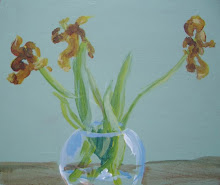
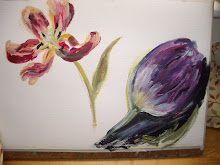
Why do my tulips never fit the page or canvas? nearly every time I have drawn or painted tulips in a vase they don't fit. The tulips feel cramped or the vase fills the space and there's no room left. It feels as if I love to paint the flowers but can't allow myself the space they need. After the last experience I thought maybe I needed a smaller brush and a bigger space but, while reading about the body and how Chinese calligraphers write and draw through their bodies, I came to see that the problem lies elsewhere.
First I read about "the body proper" which is a phrase from phenomenology, a kind of old, antique phrase where the adjective proper follows the noun in a kind of French fashion and also means something other than what it appears to. The idea is that we inhabit our bodies and experience the world through our inhabited bodies, in fact we can only know the world from inside our bodies. We then have to imagine how it is to be someone else; from the inside of our bodies we see the outside of their bodies and imagine their internal life. Not only that, but our bodies only exist and understand through our activity in physical space, so that all this is dynamic and spatial. These ideas fit with what I know of contemporary cognitive science -- embodiment as trying to eliminate false boundaries between mind and body and world; proprioception as the feeling of oneself from the inside; theory of mind as the process of understanding about other people.
And in art, the importance of this is that when we paint or draw something we are using our embodied, proprioceptive, spatial, understandings. Perhaps I cannot draw the tulips because I do not understand, from the inside of myself, how the tulips and the vase and the table they stand on occupy their space? It's as if I know the petals and the shape of the flowers, but what I don't know is how they fit into the space around them.
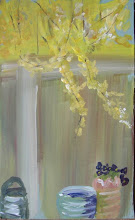
So today I tried to get to know these things better. I walk around the table. I think about the cylinders in space formed by the round table going down to the floor and up to the ceiling. I feel the vase, actually a jug, cold and round in my hands. I walk around the table. I feel the flowers, the stalks thrusting forward and outwards, their heads full and falling slightly. Then I tried to paint all of that, the space and the flowers, not just the flowers.
I added the light as more solid material in space -- oblong slabs of light from the small window.
This feels much better! although the flowers are still too big for the vase..
Monday, 30 March 2009
My arms, and tulips
trying to paint every day -- well not so much trying, as allowing myself the gorgeous treat of painting every day.
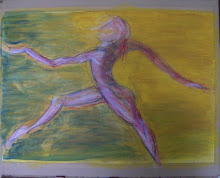
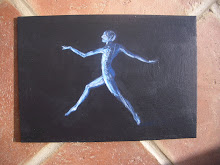
The two paintings that I've called My Arms were inspired by a photograph of an Australian ballet dancer. First I did the small painting on a black background, using just cobalt blue and white. I quite liked the x-ray effect, and being delicate, which is not how I see myself but with all these miniatures turns out perhaps to be part of me or part of how I paint. Then I did a large painting on a yellow ochre background which took several days and was very frustrating to work with. I used a blue watercolour pencil over the top of the first, annoying, image, and the frustration produced sweeping strokes that I quite liked. By this point, the paper was buckling. I tried to keep the pleasing strokes by painting more yellow ochre over the top, before stretching the watercolour paper, which should have been done first but wasn't. Then inside the pencil strokes I put glazes of rose and white to get the muscle shapes. Then I wanted a dark background on the left-hand side. Now it sits like this, still taped to my board because I know it's not finished but I'm not sure what happens next. I suppose I have to wait and see..
When I photographed the pictures and saw them on my screen, I realised that my body had painted my body, at least my arms. To avoid tingling and numb fingers in the night, I have to sleep with my arms straight or stretched out; when I'm half asleep, it feels as if my arms are miles long, stretching out into the distance.
The tulips were painted yesterday and seem to be moving in the same way. Again, I don't think this picture is finished but there are bits of it I like so much, but I'm scared to do more in case I lose them. Perhaps somewhere in here is the solution... draw boxes around the bits I like and keep them while painting the rest? if it was on paper I could cut them out and collage.. how to take a risk?
The two paintings that I've called My Arms were inspired by a photograph of an Australian ballet dancer. First I did the small painting on a black background, using just cobalt blue and white. I quite liked the x-ray effect, and being delicate, which is not how I see myself but with all these miniatures turns out perhaps to be part of me or part of how I paint. Then I did a large painting on a yellow ochre background which took several days and was very frustrating to work with. I used a blue watercolour pencil over the top of the first, annoying, image, and the frustration produced sweeping strokes that I quite liked. By this point, the paper was buckling. I tried to keep the pleasing strokes by painting more yellow ochre over the top, before stretching the watercolour paper, which should have been done first but wasn't. Then inside the pencil strokes I put glazes of rose and white to get the muscle shapes. Then I wanted a dark background on the left-hand side. Now it sits like this, still taped to my board because I know it's not finished but I'm not sure what happens next. I suppose I have to wait and see..
When I photographed the pictures and saw them on my screen, I realised that my body had painted my body, at least my arms. To avoid tingling and numb fingers in the night, I have to sleep with my arms straight or stretched out; when I'm half asleep, it feels as if my arms are miles long, stretching out into the distance.
The tulips were painted yesterday and seem to be moving in the same way. Again, I don't think this picture is finished but there are bits of it I like so much, but I'm scared to do more in case I lose them. Perhaps somewhere in here is the solution... draw boxes around the bits I like and keep them while painting the rest? if it was on paper I could cut them out and collage.. how to take a risk?
Friday, 13 March 2009
A set of miniature pictures
Last Sunday I went for a walk around the wood to see what was happening spring-wise. The bluebell leaves are pushing up through the dead oak leaves. Honeysuckle has the first new leaves at the top of its climbing stems. On the trees, buds are thickening, colouring, preparing. Birds are busy and pursuing conversations across hedgerows. No primroses yet, although in the city the verges are already full of them.
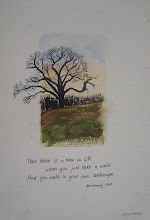
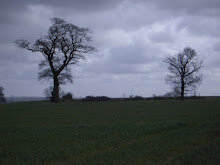
I had an idea to paint the trees that I've been scrutinising and drawing for the last weeks, determined to capture their winter shapes. Around here the trees stand against the skyline, often growing out of hedges, and when they are bare, the different shapes are very clear. The stag-headed oaks have branches that die off and remain amongst the living tree, sharp and spiky. On the road to town, there is a copper beech whose branches curve around and go back the way they came, creating the most beautiful fluid shape.
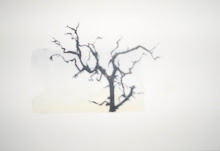
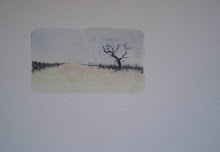
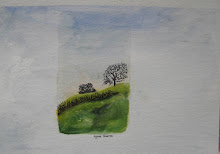
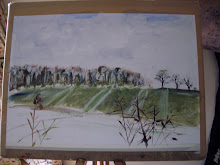
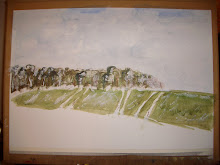
To make the miniatures, I take small sheets watercolour paper -- about 8" x 4" -- and draw a rectangle inside them. I use the acrylics very wet on the moistened rectangle to make country skies and rolling fields. When they are dry, I use my pen or paint to whisper a hedge, to grow a tree. Some of the trees grow out of their rectangular screen. The stag-headed oaks spike against their skies. Mostly the trees insist on remaining alone.
I want to add writing but can't yet work out how to do it. Scared of spoiling what I have done.
I had an idea to paint the trees that I've been scrutinising and drawing for the last weeks, determined to capture their winter shapes. Around here the trees stand against the skyline, often growing out of hedges, and when they are bare, the different shapes are very clear. The stag-headed oaks have branches that die off and remain amongst the living tree, sharp and spiky. On the road to town, there is a copper beech whose branches curve around and go back the way they came, creating the most beautiful fluid shape.
To make the miniatures, I take small sheets watercolour paper -- about 8" x 4" -- and draw a rectangle inside them. I use the acrylics very wet on the moistened rectangle to make country skies and rolling fields. When they are dry, I use my pen or paint to whisper a hedge, to grow a tree. Some of the trees grow out of their rectangular screen. The stag-headed oaks spike against their skies. Mostly the trees insist on remaining alone.
I want to add writing but can't yet work out how to do it. Scared of spoiling what I have done.
Wednesday, 28 January 2009
Contingency
I see it is months since I posted anything. So here are some new paintings. I wonder if the things I learned about colour mixing on my course show through? I am definitely thinking more about warm colours and cool colours, and how colours work with and against each other. I suspect that thinking so consciously about colour may temporarily affect other parts of my painting. I wrote about 'contingency' - how what we do at any moment is affected by what we've just done, what other people are doing at that moment, by the physical context and so on. Contingency is key to understanding the dynamics of speaking, writing or painting. Contingency is not just about the moment but about what happens in the moment as a result of everything else; and I mean everything, physical - social - cultural - political - historical...
Friday, 31 October 2008
Slade course
I started a new course "Painting 1" at the Slade in London. It feels like a brave and exciting thing to do - I love the studios with high ceilings and proper easels - so good to have the right equipment and space.
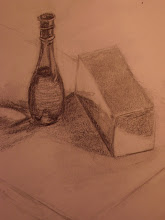
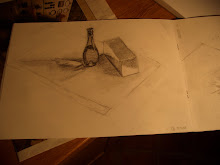
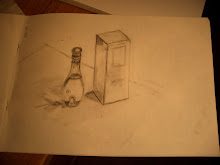
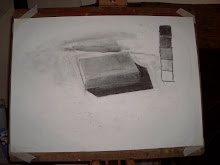
We made a paper box and cone, stuck them on paper and put them on the wall to draw. Homework is to draw a matchbox. I spent a week in Brazil at a conference, and some time waiting in my room passed happily drawing the box of shortbread I always take travelling to sustain, and the perfume bottle and box I bought on a whim on the plane. Whims are good, and healthy.
I recalled Giacometti - every time I look at what I am painting, it has changed. Even the shadows keep developing with looking. Strips of light appear in the matchbox's shadow, a darker line along the edge of what seemed dark before. Looking changes the seeing.
We made a paper box and cone, stuck them on paper and put them on the wall to draw. Homework is to draw a matchbox. I spent a week in Brazil at a conference, and some time waiting in my room passed happily drawing the box of shortbread I always take travelling to sustain, and the perfume bottle and box I bought on a whim on the plane. Whims are good, and healthy.
I recalled Giacometti - every time I look at what I am painting, it has changed. Even the shadows keep developing with looking. Strips of light appear in the matchbox's shadow, a darker line along the edge of what seemed dark before. Looking changes the seeing.
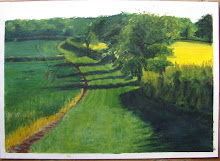
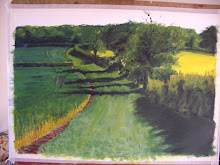
Getting the shadows 'right'
My artist friend challenged me to do more with the shadows in the Walk to the Woods painting. So I struggled on and eventually it did improve. I also worked on how to show the path in the foreground rising slightly before dropping away.
David Hockney in "Secret Knowledge", the film, said that, while a picture seen through a glass lens goes out of focus in the distance, what we see with our human eyes does not; it stays in focus, and is just far away. At least, I think that is what he said. It feels right too. When I look towards the wood, I feel that I can see the wood in focus and far away. I cannot see the details because they are too small, but I can see clearly what I can see. I talked about this with my artist friend, but I don't think she believed me,
David Hockney in "Secret Knowledge", the film, said that, while a picture seen through a glass lens goes out of focus in the distance, what we see with our human eyes does not; it stays in focus, and is just far away. At least, I think that is what he said. It feels right too. When I look towards the wood, I feel that I can see the wood in focus and far away. I cannot see the details because they are too small, but I can see clearly what I can see. I talked about this with my artist friend, but I don't think she believed me,
Monday, 22 September 2008
New term, new class
It's September, autumn beginning, and a new class 'mixed media'. More later. Meanwhile another country painting.
Monday, 25 August 2008
More pictures
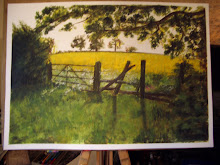
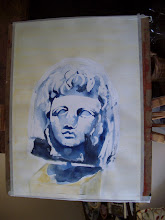
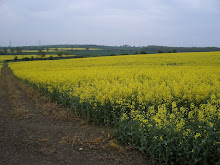
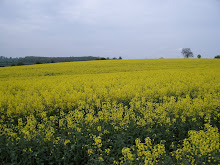
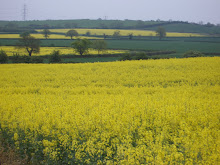
Another rape field, this time through a gate, took shape over several days after my operation. And a roman statue, that involved just one central colour, dark and watered down, with masking fluid - this too was seen in the Merida museum. And a picture copied from a card of Cotton Grass flowers - using acrylic like watercolour, paynes grey and yellow ochre with a little rose, and masking fluid, with some pen work. A challenge to work out how to do it, but the photographer saw its beauty first.
back to back to art
After carpal tunnel surgery - still sore but healing.
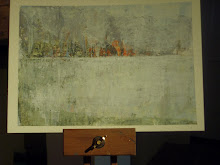
The vermillion picture was finished. I added lines that seemed to be needed and Roman vases found in Spain, now in the museum in Merida. The picture has the archaeological layers I wanted. It feels an odd creation, a strangeness.
The vermillion picture was finished. I added lines that seemed to be needed and Roman vases found in Spain, now in the museum in Merida. The picture has the archaeological layers I wanted. It feels an odd creation, a strangeness.
Tuesday, 8 July 2008
Vermillion and a project
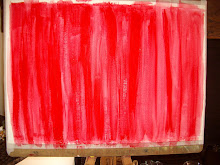
When I heard that J was ill, seriously ill, there was a need to paint. And a new sheet of watercolour paper was painted with vermillion hue -- it seemed to say something about her energy and love of life. Nothing happened to the painting; the painted sheet stayed on my drawing board on the easel for several weeks.
In the third art class, we started a "project". We began by mind mapping on a large sheet of paper in the middle of which we were to write or to think "what do I like to draw?". At the time, this question came as a loud and shocking reminder that we don't need permission to enjoy. What do I like, not what do I have to do or what should I do! It's okay to do something because I like doing it -- and actually I ought to do it just because I like doing it, and I'm likely to do it really well because I like doing it. (How to make this happen at work too?) Anyway, my mind map took in: the pleasure of drawing beautiful Greek statues, not as stone but as somehow alive; the lively beauty of the Roman pots and vases in the museum in Spain, placed on a shelf in a way that made them dance; and the beauty of the Latin writing inscribed in stone that could be read after 2000 years. I suppose there's a link with J. somewhere -- about human connections across time and through stone; we none of us survive physically but only through shared aesthetics and meanings. What we do or write or make may stay around and connect us to the future, even to future people not yet born; and this does nothing to take away present pain.
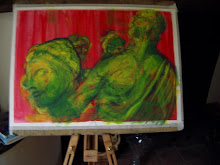
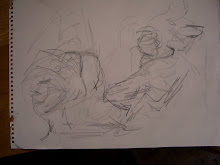
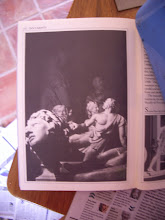
I pursued what was started in class by getting out books about Greek and Roman statues, old drawings. In one book there's a photograph of statues stacked in a museum in Lyon. There's a head at an angle raised to the light that gives a feeling of exultation or agony, a man's head and body that display strength and power, and in the background, other busts watching like an audience. Just as the little vases in the museum became a piece of art by accident, so this photograph is a beautiful picture as if by chance. I did a quick rough drawing to get the feel of where things were. Then I used yellow and green acrylic paint on top of the vermillion, and the pencil I love best -- Indigo watercolour -- to scratch through the paint, draw on the paint and mix with the paint. As usual, I was frustrated by some details, especially in the mouth and nose of the foremost head, and working on it lost some of the spontaneity of other parts of the painting.
Today as I vacuum cleaned underneath the easel, I decided it needed more layers and that I still want to try those dancing vases on the glass shelf in the museum -- and I think in the photograph is also an image of me reflected in the glass case in front of them -- layers across time. So I've added a wash of vermillion hue, very wet, over the painting but of course some of the yellow was so beautiful I didn't want to lose it, so I took out bits of the vermillion wash. I'll add another wash and then leave it until after my holiday.
In the third art class, we started a "project". We began by mind mapping on a large sheet of paper in the middle of which we were to write or to think "what do I like to draw?". At the time, this question came as a loud and shocking reminder that we don't need permission to enjoy. What do I like, not what do I have to do or what should I do! It's okay to do something because I like doing it -- and actually I ought to do it just because I like doing it, and I'm likely to do it really well because I like doing it. (How to make this happen at work too?) Anyway, my mind map took in: the pleasure of drawing beautiful Greek statues, not as stone but as somehow alive; the lively beauty of the Roman pots and vases in the museum in Spain, placed on a shelf in a way that made them dance; and the beauty of the Latin writing inscribed in stone that could be read after 2000 years. I suppose there's a link with J. somewhere -- about human connections across time and through stone; we none of us survive physically but only through shared aesthetics and meanings. What we do or write or make may stay around and connect us to the future, even to future people not yet born; and this does nothing to take away present pain.
I pursued what was started in class by getting out books about Greek and Roman statues, old drawings. In one book there's a photograph of statues stacked in a museum in Lyon. There's a head at an angle raised to the light that gives a feeling of exultation or agony, a man's head and body that display strength and power, and in the background, other busts watching like an audience. Just as the little vases in the museum became a piece of art by accident, so this photograph is a beautiful picture as if by chance. I did a quick rough drawing to get the feel of where things were. Then I used yellow and green acrylic paint on top of the vermillion, and the pencil I love best -- Indigo watercolour -- to scratch through the paint, draw on the paint and mix with the paint. As usual, I was frustrated by some details, especially in the mouth and nose of the foremost head, and working on it lost some of the spontaneity of other parts of the painting.
Today as I vacuum cleaned underneath the easel, I decided it needed more layers and that I still want to try those dancing vases on the glass shelf in the museum -- and I think in the photograph is also an image of me reflected in the glass case in front of them -- layers across time. So I've added a wash of vermillion hue, very wet, over the painting but of course some of the yellow was so beautiful I didn't want to lose it, so I took out bits of the vermillion wash. I'll add another wash and then leave it until after my holiday.
Subscribe to:
Posts (Atom)






















)